08 November 2005

A Dog of a Stock?


Blog Hog, Jonathan V. Last, e-mailed me a thesis. Once you work through the home-buying frustration, with which I sympathize fully, you get to today's stock analysis inspiration:

Economic circumstances in most of urban America are such that one of two things must happen:

1) The housing market will collapse in a significant and catastrophic way, or

2) Over the next 20 years there will be a major downward revision in the standards of American middle-class living.

The cost of real estate has become such that a normal, middle-class couple just starting out cannot purchase a single-family home in most major metro areas in America. To do even this requires two incomes. Where a single-income family was the norm two generations ago, and was increasingly rare in our generation, it will become all but non-existent in the metropolitan middle class if current trends continue.

So if the housing market is not a bubble--if it does not collapse--we're going to see the middle-class family standard changing to mean condominium instead of single-family home; 90 minute commute instead of 30 minute commute as the standard; and fewer children with the total extinction of stay-at-home moms.

What does this mean for the Pig? Look for stocks that fit with the new standards of middle class. One of those is pets, since I suspect that pets will take the place of children, since middle class families will no longer be able to afford children. I'd be very high on pet stocks.


JVL was thinking about 1-800-PetMeds, or PETS, when he sent me these thoughts. I have no idea if the housing market is a bursting bubble, or if we've established a higher price floor for urban housing. But I can evaulate some stocks. I will regale you, the reader, with the fruits of my research.

PETS is trading at about $13.40, with a 52-week range of $5.25-$14.00. The company description from MarketWatch:

Petmed Express, Inc.. The Group's principal activity is to market prescription and non- prescription pet medications, health and nutritional supplements and accessories at discounted prices through the Pet Med Express catalog, customer service representatives and on the Internet. The Group offers broad variety of products for dogs and cats.

PETS the stock has done quite well this year, up 75% during 2005 and up 125% over the last 52 weeks. However, I found mixed opinions from various analysts.
Jim Cramer disagrees with JVL's thesis. From the recap of Mad Money from 9/7/05:

PetMed Express (PETS:Nasdaq - news - research - Cramer's Take): "This pet market has been not so hot. ... I am not a fan. If you need to be in the pet business somehow, go buy a dog."

Another analyst has a positive outlook on PETS. At least it was positive a month ago, when Ladenburg Thalmann issued this press release. Since then, PETS has hit the $14 price target, then pulled back slightly.

NEW YORK, Oct 13, 2005 /PRNewswire via COMTEX/ -- Ladenburg Thalmann announced today that it has initiated coverage of PetMed Express, Inc. (PETS) with an initial Buy rating and a price target of $14 over the next 12-15 months. For a full text of the report please call (212) 409-2028.

PetMed Express ("PetMed"), the largest pet pharmacy in the U.S., sells well-known prescription and non-prescription medications and health care products for dogs, cats and horses through its internet website, catalogs and 1-800 call center.

The analyst, Ethel V. Hill, believes that PetMed is the market leader in the profitable pet pharmacy segment of the growing pet supply industry. Favorable trends of increasing pet ownership and increased spending per pet, which drove 5.9% growth in 2004 in the $34 billion supply industry, are expected to continue.

"PetMed Express holds a major share of the internet/catalog pet pharmacy segment and is the only public company in the space," said Hill. "We believe PetMed can leverage its market leadership and successful business model to double its current size in four or five years -- primarily through organic growth."


According to MarketWatch.com on November 7, 2005, Sidoti and Company set a higher price target of $15, but cut PETS to a lower rating of Neutral. (You must check out their embarassingly amateurish website.)

Here are excerpts from a cutesy stock spotlight piece on PETS from SmartMoney.com:

The company's customer base is approaching two million. Its trailing 12-month sales total $117 million — mere Kibbles n' Bits next to PetSmart's $3.6 billion and Petco's $1.9 billion. But its operating margin of more than 12% handily tops PetSmart's 9% and Petco's 8%. Operating margin has been on the rise recently for PetMed, as its larger size has created more scale over its administrative and marketing spending.

Fiscal second-quarter results for the company showed sales increasing 34% year-over-year as earnings jumped 50%. Earnings per share of 11 cents topped Wall Street estimates by a penny. Customer acquisition costs — always a concern for young, less-known companies as they pay up to bring in business — fell for the fourth straight quarter, to $34 from $37 a year ago. Analysts say word-of-mouth marketing is likely helping. Gross margin declined to 38.4% from a year-earlier 40.4% on an increased contribution from wholesale business, higher freight costs and more aggressive pricing. But operating margin expanded to 10.3% from 9.9%.

"This price strategy is obviously driving faster than expected adoption of this disruptive online model — don't change a thing!" gushed Avondale Partners analyst Frank Gristina in a Tuesday research note. He thinks shares could fetch $15 a share within a year, or about 30 times his next-12-months earnings estimate of 53 cents. Gristina notes that the company has plenty of potential for organic growth and margin expansion, citing its anticipated roll-out of private-label merchandise as one example. He also points out that PetMed's products are more necessary than many of those sold at other pet stores (faux mink coats for cats come to mind), making them less responsive to rising gas prices, and that they're cheaper than those sold by veterinarians. (Gristina doesn't own shares of PetMed; Avondale Partners doesn't have an investment-banking relationship with the company.)

For such a fast-growing company, PetMed's valuation strikes us as modest, and then some. The stock trades at 25 times forecasted earnings for fiscal 2006 (ends March 31). And analysts figure the company will boost its earnings by 35% annually over the next five years. That gives the stock a price/earnings-to-growth, or PEG, ratio of just 0.7, vs. 1.0 for PetSmart, 0.8 for Petco and 1.5 for the broader market. The whole group looks fairly cheap right now, come to think of it, but PetMed might be the most promising pick of the litter.


Now it's time for some numbers. Numbers alone tell us very little, unless we throw in the competition's numbers. Data is from SmartMoney.com and Morningstar.com.

Name - Ticker - ROE - ROA - ROIC - PEG - FCF
PetMed Express - PETS - 41.8% - 35.00% - 41.80% - na -
('00-'05 + TTM) (.9), (1.3), (.1), .2, .4, 8.2, 14.4
PetCo - PETC - 56.80% - 12.50% - 23.82% - .87 -
('02 - '05 + TTM) 23.5, 77.3, 61.1, 52.8, 40.8
PETsMART - PETM - 19.20% - 10.80% - 15.18% - 1.15 -
('01 - '05 + TTM) 65.8, 84.9, 59.1, 74.2, 139.5, 171.4

PETS is a small-cap growth stock, and it shows in its gaudy ROA and ROIC. It's also apparent in the turnaround in free cash flow, from small negatives to substantial positive gains, as a percentage.

PETC has an attractive PEG below 1, and its ROIC is better than PETM's. PETC has declining free cash flow over the past four years. YTD, the stock is down 46%.

PETM has the weakest return numbers of the three, but has very attractive free cash flow growth. YTD, PETM is down 30%.

Do we just listen to Cramer and buy a dog? Or if we invest in one of these three stocks, will we still by buying a dog?

The price of PETS has run up nicely based on strong numbers and investor interest. PETC and PETM as stocks have performed terribly this year, but now could be considered cheap. The value investor in me would favor PETM and its steadily increasing free cash flow.

These three stocks are going into the doghouse, where we can keep an eye on them.

07 November 2005

Splenda


Splenda is great. I was tempted to say "splendid" but that's too obvious. It sweetens my coffee, and the cans of Pepsi One I favor at the office. I'm dropping some weight avoid sugar, while maintaining the requisite caffeination that keeps me working, and blogging.

I put up with Aspartame (Equal) in Diet Coke, but it has always tasted fake and cloying to me. Saccharin (Sweet and Low) had appetizing cancer warnings printed on the pink packets when I was younger, so I never warmed to the stuff.

While I was drinking some coffee last night, I thought, how can I make money off of this great product that's appearing in more food and beverages, every day?

I put down my patent bar materials and went to work on Google. What I found was not very promising as Business Week cast a suspicious eye over the British maker of Spenda back in January. Splenda is a success, but capacity and competition issues, along with a stock price run-up, make its maker a questionable investment.

It's Not All Sweetness for Splenda
Although the sugar substitute's British maker, Tate & Lyle, has seen
its stock rise smartly, analysts doubt this high will last
For a slow-growth maker of sugar and starch whose roots go back to the
mid-19th century, Britain's Tate & Lyle was an unexpected success
story in 2004. It started off last year warning that due to rising raw
materials costs it wouldn't meet profit forecasts. But by November it
boasted a 9% jump in profits in the prior six months. And by yearend,
Tate & Lyle's stock price was at $8.86 on the London stock change, a
jump of nearly 50% from $5.94 when 2004 began. It was recently
readmitted into the blue chip FTSE 100-stock index after being out for
seven years.

The reason for Tate & Lyle's turnaround? The newfound popularity of
sucralose, a sweetener it manufactures that's used as an ingredient in
low-calorie products and sold in tabletop form under the name Splenda.
While sales of the sweetener, which was approved in the U.S. in 1998,
seem set to grow worldwide for years to come, that doesn't mean shares
of Tate & Lyle, (which has a thinly traded American depositary receipt
[ADR] that trades over-the-counter in the U.S. with the symbol TATYY
), will continue to soar in 2005. Analysts who cover the sugarmaker
warn some potential bitterness may be ahead.

The reasons have nothing to do with sucralose's popularity. Indeed,
Splenda is gaining market share over other tabletop sweeteners. Its
sales have grown 126% in the past two years while rival sugar
substitutes have declined by 8%, according to research firm Mintel
International Group. The sweetener is also being used as an additive
in a growing number of packaged foods.

A CLEAR WINNER. Unlike artificial sweeteners like aspartame,
sucralose retains its taste after being heated, which means it can be
used as an ingredient in products that are baked and pasteurized. It
was used in 1,436 new products worldwide in 2004, up from 573 in 2003
and 35 when research firm Datamonitor started tracking it in 1999.
Sucralose "was one of the major trends for the last year," says Tom
Vierhile, executive editor of Datamonitor's new-product database
Productscan Online.

In an era of heightened concern over obesity and devotion to low-carb
eating, sucralose has been a clear winner. And Tate & Lyle is its sole
manufacturer, thanks to an agreement arranged last February with its
longstanding partner in the sucralose business, Johnson & Johnson's
(JNJ ) McNeil Nutritionals, which markets Splenda in the U.S.
...
CAPACITY BOTTLENECK. That doesn't mean the profit growth and stock
gains will continue for long, however. Despite sucralose's popularity,
Tate & Lyle faces several major hurdles that could trip it up in 2005,
warn analysts.

The most immediate problem: Tate & Lyle can't produce enough sucralose
to meet demand. In November, it announced that it wouldn't be taking
on new customers until it had increased its production capacity. Tate
& Lyle is spending $75 million to double capacity in its single
existing sucralose manufacturing plant in Alabama by 2006. It's also
building a new $175 million factory in Singapore that will be ready in
2007. Until those plants come on-line, Tate & Lyle won't be able to
handle a big increase in new customers or products.

Increased competition is another threat. With growing demand for sugar
substitutes, new products are likely to come on the market.
NutraSweet, which sells the sugar substitute aspartame, has begun
selling a new sweetener called neotame as an ingredient in beverages,
sweets, and ready-to-eat meals. "We see the category as such that
there's room for a lot of players," says Kevin Bauer, senior
vice-president for marketing at NutraSweet.
...
And the stock isn't cheap relative to its historical valuation.
Merrill Lynch analysts wrote in a November report that the price was
already "almost entirely factoring in the benefits from the additional
capacity for Splenda production including the additional plant in
Singapore."


Here is an update on Sucralose performance and production from Tate & Lyle on November 3, 2005:

Profits of GBP 33 million ($60 million) from our SPLENDA(R) Sucralose business were GBP 7 million ($13 million) higher than in the comparative period. GBP 4 million ($7 million) of the increase was due to an IFRS stock adjustment in the comparative period. Market share increased in all three sectors (food, beverage and pharmaceutical).

There have been a number of major US diet beverage product launches with SPLENDA(R) Sucralose in the period as well as flavoured waters. During the last eighteen months the "Sweetened with SPLENDA(R)" brand logo has been approved for use on over 1,200 consumer products.

Sales totalled GBP 74 million ($135 million), (GBP 62 million, $113 million). Demand continued to outstrip production even though capacity was increased during the period as part of the first expansion project at the McIntosh, Alabama plant was brought on stream. The completion of this and the second expansion project at McIntosh, both due to be finished by April 2006, are on schedule and on budget, as is the building of a new plant in Singapore with a completion date of January 2007.


What about the also-rans, I mean, Splenda's competition?

Merisant, the company that bought Equal from Monsanto, is private.
Merisant spun off NutraSweet, which is also private. Cumberland
Packing owns the saccharin brand Sweet & Low
...

wait for it

...

it's private.

Hoovers' website helped me piece together these competitors and also
to find out their inaccessibility to my investing dollars. Until I hit
Alberto-Culver (ACV), owner of many consumer brands, including the
saccharin product, Sugar Twin. The sighting of a yellow packet amidst
the blue and pink packets of artificial sweeteners used to be rare.
That rare appearance was brought to you by Sugar Twin.

So, for comparison's and completeness sake, let's look at
TATYY, ACV, and JNJ.

TATYY is the ADR for Tate & Lyle. It trades for around $34.50, but I'm not interested in an obscure, low-volume security. And I'm not interested in buying stocks that trade on the FTSE.

ACV trades for around $42.50 per share. Its ROIC is 13.01% according to SmartMoney.com. Its P/E is around 18, and is trading within a dollar of its 52-week low, $14 below its 52-week high. Free cash flow for '04 was $184.6M. The average annual increase in free cash flow over five years is %39.9.

JNJ trades for around $61.30 per share. Its ROIC is 25.72% according to SmartMoney.com. Its P/E is around 19, and is trading about $4 above its 52-week low, almost $9 off its 52-week high. Free cash flow for '04 was $8.956B. The average annual increase in free cash flow over five years is 19.9%.

ACV makes its money in beauty supply, not in its miniscule sugar substitute business.

JNJ generates a tremendous amount of cash. Increased Splenda usage contributes to this, but it is a mere pittance if Tate & Lyle is boasting about sales of $135 million. Really, JNJ is not much of a Splenda play. The pressing concern with JNJ is the coming litigation over the messy Guidant takeover.

Perhaps I should pour another cuppa Joe, add a dash of Splenda, and leave it at that.

04 November 2005

What a Pig Sty!

I noticed a stench over on the WershovenistPig Stock Watch List. Some of the stocks have really started to stink things up, with missed earnings targets and debt ratings cuts. It's time to see which stocks can be salvaged, like slicing off the moldy part of a cheese, versus those stocks which are completely rotten.

The stinkers are MRH, SNAK, CUB, and DWRI.


The news from MRH is particularly depressing. This morning on MarketWatch, Fitch cut MRH's financial strength rating to BBB from A-, and its debt rating to BB from BBB-. I believe that puts MRH's financial strength at Fitch's lowest investment grade, and its debt into junk status.

The size of the company's catastrophe losses -- at more than $1 billion -- suggest the risks it assumed were too concentrated for a reinsurer rated A-. The losses also undermine confidence in the underwriting abilities of the company and raise significant uncertainty about its performance in the face of future catastrophes, Fitch said.

This comes after Reuters reported that MRH lost almost $900M in the last quarter:

NEW YORK, Nov 2 (Reuters) - Montpelier Re Holdings Ltd. (MRH.N: Quote, Profile, Research)
said on Wednesday it posted a wider-than-expected quarterly loss of
$875.1 million, after suffering big losses from hurricanes.
Reinsurers, who provide extra coverage for regular carriers who
want to limit their risk, have lost of billions of dollars from
Hurricanes Katrina and Rita.
Montpelier Re estimates it paid out $972 million from
catastrophes in the third quarter, including $809 million from
Hurricane Katrina and $141 million from Rita.
For the third quarter the company had a loss of $12.16 a share,
compared with a loss of $78.2 million, or $1.26 a share in the same
quarter last year.
Operating losses before taxes were $891.4 million in the
quarter, or $12.39 a share, wider than the company's year ago
operating loss of $81.2 million, or $1.31 a share.
Analysts expected the company to post a loss of $8.40 a share,
according to Reuters Estimates.
The company's total shareholder equity fell to $1.1 billion in
the quarter ended Sept. 30 from $1.8 billion at the end of last
year.


I learned of MRH through Cramer on Mad Money and Real Money. He touted it as an interesting small player with a nice dividend. At the time, the stock had taken a hit, going from trading in the mid-$30's to the mid-$20's. Now, the stock is trading around $18, giving it a dividend yield of almost 9%, that is, if the current dividend can be maintained, considering MRH's cash issues. To give Cramer some credit, he quickly turned bearish on the stock after it dropped only a couple of dollars.

The third-quarter losses were 50% higher than analysts expected. Ooof.


SNAK is tasting a bit rancid, too:

Poore Brothers Reports Third-Quarter Loss of $0.02 Per Share

GOODYEAR, Ariz., Oct 27, 2005 (BUSINESS WIRE) -- Poore Brothers, Inc. (SNAK ) today reported financial results for the third quarter (fourteen weeks) and nine months ended October 1, 2005.

Net revenues for the third quarter of fiscal 2005 were $18.5 million, 8% above last year's third quarter net revenues of $17.2 million. The net loss of $(0.4) million, or $(0.02) per share, this year compared to net income of $1.0 million, or $0.05 per basic and diluted share last year. The reduced profitability was the result of $2.5 million in trade spending programs initiated to aggressively drive revenue growth in T.G.I. Friday's(R), Boulder Canyon Natural Foods(TM) and Cinnabon(R) brands. The Company's third-quarter gross revenue shipments, before deductions for trade spending, grew 24% versus last year.

Mr. Thomas W. Freeze, President and Chief Executive Officer, commented, "We are encouraged by our shipment growth, but not satisfied with our financial performance this past quarter. We invested significantly in the Cinnabon(R) brand market test and in a big promotional event for the re-launch of the Boulder Canyon Natural Foods(TM) brand potato chips. We simultaneously experienced lower than expected results from our trade spending programs for the T.G.I. Friday's(R) brand across several channels. While the programs generated higher revenue, the additional volume was not sufficient to offset their costs. Despite recent financial performance, we remain excited about the future for all of our licensed brands. In addition, we separately have announced the signing of a nonbinding letter of intent to acquire the Mrs. Fields(R) brand licenses from Shadewell Grove to produce and sell ready-to-eat cookies, baking chips, brownies and toppings into many of the same distribution channels we presently sell."

In the third quarter T.G.I. Friday's(R) brand salted snacks net revenue grew 1% to $12.4 million as the previously mentioned higher trade spending programs in grocery, convenience store and mass merchandiser channels offset the 12% gross revenue growth, but did not generate sufficient volume to offset their costs. Overall, the T.G.I. Friday's(R) brand represented 67% of total net revenue in the third quarter. The Cinnabon(R) brand cookie market test continued in the third quarter and generated $1.3 million in gross revenue from a variety of new customers in the grocery and convenience store channels. The Company overestimated sell through consumption in connection with the large initial promotional order from a mass merchandiser which resulted in a charge of $0.7 million to mark-down and dispose of estimated excess inventory. The Company remains committed to the Cinnabon(R) brand's success and to developing and testing new products and promotional strategies. The Company's potato chip brands' net revenues grew 13% due to strong promotional activity, particularly on the Boulder Canyon Natural Foods(TM) brand. Distributed products net revenue also grew 73% over the prior year due to increased product lines.
...
Mr. Richard M. Finkbeiner, Senior Vice President and Chief Financial Officer, added, "As a result of our third quarter performance, we believe that we will be nearer the lower end of our previously provided guidance for the full year of $75-$85 million in net revenue, but we will not meet our earnings per share target of $0.18-$0.23 per share. We now feel that our earnings per share for the full year will be between $0.08-$0.10 per share."

Mr. Freeze concluded, "While we are disappointed about our short-term financial performance, we are optimistic that our broad array of growth initiatives, including (i) Cinnabon(R) cookies and other items, (ii) Boulder Canyon Natural Foods(TM) new products, such as organic tortilla chips, soy crisps, and soy tortilla chips, (iii) acquisitions, (iv) Panda Express(R) snack concepts, and (v) other licensing opportunities, provides a broad platform upon which to reach our long-term goal of building a $200 million profitable food company. Our innovation capability with brands and products, while not always successful in the marketplace, remains the cornerstone to our future success."


SNAK, a volatile small-cap stock, has been trading between $4.50 and $6.50 over the last few months. Apparently, Poore Brothers spent too much money getting people to try out their chips. Executives lowered earnings guidance by half. The stock has slumped to the $3.50 range.


MarketWatch recently reported Cubic's big big news:

U.S. Navy Chooses Cubic Team for Opportunity to Bid on Computer Simulations for Ship Systems

SAN DIEGO, Nov 01, 2005 (BUSINESS WIRE) -- Cubic Defense Applications, the defense segment of Cubic Corporation (CUB), has received a contract for the U.S. Navy's Generic Reconfigurable Training Systems (GRTS) Lot II program. The indefinite delivery, indefinite quantity (ID/IQ) contract has a ceiling value of $15 million, and covers computer simulations for training crews in how to operate the hull, mechanical and electrical systems of Navy ships.

Cubic's Orlando, Fla.-based Simulation Systems Division is among several contractors that will have an opportunity to bid on up to $15 million in ship systems simulator business over the next five years. The companies will compete for contracts to develop modeling and simulation software to train crews to operate a ship's basic systems, including diesel and turbine engines, propulsion systems, generator systems, and damage control and related systems. These simulation models will run in a standardized Navy electronic classroom environment and offer a "whole-ship" environment for simultaneous training on multiple duty stations.


Wow! CUB's touting in a press release an opportunity to bid, not the award of a contract. And it's a contract for up to $15M, meaning, anywhere from bupkus to the full $15M. Over the next five, count 'em, five years.

This is a stock I read about in the New York Times in an article on subway security. Cramer read the same article and talked up the stock on his show. Again, he covered his ass by warning viewers that he was not a fan of the company's performance. Looking at CUB's free cash flow numbers at Morningstar, they have declined from $34.1M in '00 to $4.5M in '02, to -$35.1M in '04. That and its sad example of a press release, and it's no wonder the stock is trading near its 52-week low, the only uptick coming from the "Cramer effect" of people buying the stock just as he mentions it on the show.


I'm not going to pick on DWRI much, since it's announcing its third-quarter results on the 10th. However, DWRI is trading at around $8 a share, near its 52-week low, and at around 60% off its peak. I'm not one for chart analysis, but this stock is on a straight downward decline. Free cash flow, from Morningstar, was -$6.0M in '03 and -$4.3M in '04. In the trailing twelve months, DWRI has crapped out a whopping -$12.6M in free cash flow. I think someone piddled on the stylish cashmere rug over at DWRI.

03 November 2005

TWX Update - "They're all coming together at a classic bottom."

Considering my "unleashing shareholder value" digression in the previous post, I really should be sleeping right now, dreaming up some more bizarre blog fodder.

But I had to surf on over to the New York Times before going to bed. And there it was, an expectation of record free cash flow at TWX!

Time Warner has said it expects record revenue and free cash flow in 2005, and yesterday reported an 80 percent increase in third-quarter earnings. Until media stocks regain favor, Mr. Parsons said, all he can do is manage his company's businesses and capital for growth.

Aryeh Bourkoff, who follows media companies at UBS Securities, said that media stocks were generally trading around 15 times next year's free cash flow. (Free cash flow is the money left over after companies pay all their cash expenses, including taxes. Investors often use this as a performance gauge because free cash flow is effectively what is left to pay investors.)

By that measure, the stocks are not expensive, offering media investors an effective return of about 6 percent.

But that has not alleviated worries about the future, particularly because companies are still struggling to figure out, among other things, a model for selling content over the Internet or on cellphones. And investors recall the many wayward Internet investments that big media companies made late in the dot-com boom, most notably the financially disastrous combination of America Online and Time Warner.


Okay, so it's your typical journalistic "on one hand, but on the other hand." What I see is, in spite of the boffo earnings and cash flow, Wall Street still has the bitter taste of the AOL merger in its mouth. Eventually, these bad memories will subside, especially if Parsons continues to deliver quality results.

The article closes with a value investor's, or any investor's wet dream, the discovery of a market bottom. Yes, I do recognize the innuendos inherent in the line, "They're all coming together at a classic bottom."

Mario J. Gabelli, chief executive of Gamco Investors, whose mutual funds own shares in numerous media companies, is betting that prices will rise when leveraged buyout firms begin making more acquisitions in this area.

"What we need is a transaction of an L.B.O. group coming in and reconfirming some multiples here," Mr. Gabelli said.

But the situation may get worse before it gets better. Eventually, though, new opportunities are bound to emerge.

"The market is just dumping these stocks en masse," Mr. Gabelli said. "They're all coming together at a classic bottom."

TWX - Another cheap media stock with a buyback?


Time Warner (TWX) has been on my radar for years now.

Why?

There are a few random reasons for this.

One, its former CEO, Gerald Levin, used to be one of my alma mater's most famous alumni. Since he was one of the masterminds behind merging with AOL at its market peak, Levin is now one of Haverford's most infamous alums, right up there with Mr. Anna Nicole Smith himself, J. Howard Marshall, III.

Two, an investing idea dawned on me back in mid-2002 when then AOL Time Warner plummeted to around $9 a share. The idea is to buy stocks when there's bad news, but not really bad news, or BNBNRBN, a horrible acronym if there ever was one. I thought the AOL acquisition was terrible, but other underlying businesses like Time Warner Cable and HBO meant that there were some solid cash-generating companies mixed into the unwieldy conglomerate. I really wanted to buy some shares three years ago, and test my BNBNRBN thesis. Too bad paying off my credit cards took priority at the time.

And three, I have everyday exposure to Time Warner's products and services. I subscribe to Time Warner Cable. Watch HBO and CNN. Listen to bands on Time Warner labels (that's now a spun-off company, I believe). Watched films and television shows produced by them.

TWX has also been stuck in a rut between $14-$20 for the last two years, even though post-Levin CEO Dick Parsons smartly demoted AOL to a mere subsidiary, and ousted Steve Case from the board.

So, should I look at TWX as a long-term investment? It's now got a dividend yield around 1.1%. The stock buyback has been upped from $5B to $12.5B, in an attempt to boost the share price. There seems to be good news for shareholders coming out of TWX after the AOL-induced drought, from the AP:

...Per-share earnings came in at 19 cents compared with 11 cents a year ago. Analysts polled by Thomson Financial were expecting a profit of 17 cents per share.

Revenues rose 6.1 percent to $10.54 billion from $9.94 billion.

At the same time, the company also announced that its board of directors had approved an increase in its share buyback program to $12.5 billion over the next 21 months, up from the previous level of $5 billion.

Shareholders have been clamoring for Time Warner to take steps to lift its moribund share price, which is still about 75 percent below the levels it saw prior to agreeing to be bought in early 2000 by AOL. That deal resulted in shareholder lawsuits, regulatory scrutiny and a management purge.

The third-quarter gains were driven by strong showings in cable TV, which benefited from customers signing up for more premium services like high-speed Internet and digital phone, and cable networks, which had gains from the syndication of HBO's ''Sex and the City'' and higher advertising.
...
Revenue at AOL declined 5 percent in the quarter on a 10 percent decline in revenues from subscriptions, which more than offset a 28 percent rise in online advertising. AOL lost another 678,000 subscribers in the period, ending the quarter with 20.1 million U.S. members. However, earnings rose 16 percent on lower network and marketing costs.

AOL was long seen as a drag on Time Warner due to the steady decline of the dial-up Internet access business, but in recent months AOL has been successfully revamping its business model, moving away from the subscription business and selling more online advertising, as investor favorites Google Inc. and Yahoo Inc. do. AOL is now the subject of acquisition talks with those and other suitors.


I attempted a quick DFCF model using the following data:
Share Price of TWX = $17.90
Shares Outstanding = 4.69B
FCF = $3644M
Perpetuity Growth Rate = 3%
Discount Rate = 10%
FCF Growth Rate = I pulled 3% from my keyster since TWX's FCF grew 129% between '01 and '02, but declined 2.34% the following year, with another 3.23% decline from '03 - '04. '04 to the TTM has FCF up 1.39%. This is where the model gets, um, artsy.

Using this data, I processed the sausage to come up with $11.44 per share.

So maybe TWX isn't so cheap, but I'm not about to let my model get in the way. I think the board's focus on unleashing shareholder value is very attractive, or even sexy.

I must digress. I love that cliche "unleashing shareholder value", like shareholder value is a pit bull tied to a tree, with steaks sizzling on an unattended grill, just inches beyond the taut length of the leash. The pooch strains, choking himself on the collar. The dog drools. He wants steak, like any dog. He wants to chomp whoever tied him up like this. The neighborhood kids don't ride their big wheels near the yard where Shareholder Value lives. Especially when he's hungry.

Oh boy, it's late. I'm now imagining Shareholder Value as Chopper from Stand By Me.

Any thoughts on TWX? Anyone bearish in spite of the good news?

01 November 2005

A Cheap $750 Media Stock?


No, Google didn't double in price overnight, although it's climbing towards $400. Pigeon-holing GOOG as a media stock is narrow-minded. And I would never ever ever call Google cheap.

However, I think I stumbled across a cheap $750 media stock this morning while perusing the Morningstar homepage.

Washington Post Company WPO
Business Risk: Below Average
Economic Moat: Wide
Media analyst James Walden thinks Washington Post's ROICs should be greater than 25% (excluding goodwill) for the next few years, thanks to its recent investments in cable and education businesses. Washington Post also has a unique corporate culture that stresses long-term results, an important sign of an economic moat. From the Analyst Report: "Washington Post is best known for its flagship newspaper and Newsweek magazine. Perhaps less well-known is that the company also owns and operates several TV stations, which normally throw off loads of cash thanks to operating margins that approach 50% during election years. Beyond its solid line of businesses, one of Washington Post's greatest assets is its management. The executive team continually emphasizes long-term improvement over quarterly forecasts."


Here's a company profile from Marketwatch.com:

Washington Post Co. The Group's principal activities are to publish newspapers (principally the Washington Post), broadcast television, own and operate cable television systems, publish magazine (Newsweek magazine) and to provide educational and career development services. The Group publishes 'The Washington Post', a morning and Sunday newspaper and The Washington Post National Weekly Edition. The Magazine publishing segment publishes Newsweek, a weekly magazine. Through its subsidiaries, the Group owns six VHF television stations. The Group provides an extensive range of educational services for children, students and professionals through its subsidiary, Kaplan Inc. In Feb-2004, the Group acquired Texas School of Business.

But isn't old media withering? The sector has been battered by Wall Street, with WPO pretty much tracking the industry's decline. Newspapers are old-fashioned, their aged readership expiring daily. The future's in the intarweb, online, in blogs.

Geez. I hope not. I like my old media (though generally in its online form) as much as my new media.

The Washington Post is a top-quality almost-the-paper-of-record. The burning bloggy spotlight focused on undermining and criticizing the New York Times seems to leave the WaPo alone. That's gotta be a good thing.

Kaplan provides test preparation services, as well as increasingly prevalent online education and degrees. Instinctively, these seem like growing, high-margin businesses that are in no danger of disappearing. The competition for admission to colleges, graduate schools, even high schools, isn't going to subside anytime soon. Kaplan has a strong brand. I bet it contributes significantly to WPO's cash flow.

Enough with my liberal-artsy thoughts, feelings, and conjecture about WPO. Let's look at some cold hard numbers (that can be manipulated, fudged, and massaged by green shade-wearing CPA's as well as by your FCF-model-wielding blogger):

According to Smartmoney.com, WPO's current ROIC is 11.80%. That's higher than its competitors, SSP (11.54%), GCI (9.81%), KRI (10.60%), and TRB (6.91%), but is lagging NYT (15.72%). Morningstar must be measuring ROIC a bit different than Smartmoney to come up with its ROIC.

Nevertheless, whether WPO is getting almost twelve cents on every dollar it puts into the business, or more than a quarter on every dollar, these are quality results.

So this leads me to a down-and-dirty DFCF model for WPO to see what kind of on-the-spot valuation I can put on their stock.

I used the following information, grabbed from Morningstar.com, Marketwatch.com, and my head:
Share Price = $748.25
Outstanding Shares = 9.59M
Perpetuity Growth Rate (g) = 3%
Discount Rate (R) = 10%
Current FCF = $315.3M
Average FCF Growth Rate over Past 5 Years = 39.5%

Mixing all these numbers in a smoking cauldron left over from Halloween, I came up with a DFCF value of $3736.26 per share of WPO, almost five times the current share price. I admit the Average FCF Growth Rate of 39.5% is a little generous, but that's how my calculations played out. No matter, the professionals at Morningstar say that WPO is currently trading at below their fair value estimate, i.e. it's bargain at $750.

UPDATE. I missed a step on my DFCF model. I neglected to add in the sum of the DFCFs. The correct model comes up with $4824.54 per share of WPO. Now the FCF growth rate looks really high.

Oil Sands Getting Noticed at TCS and Instapundit

I just wanted to note on the blog an oil sands article from TechCentralStation, referenced by Instapundit. I've distilled out the best bits:

It was a tenet of the late great economist Julian Simon that we'll never run out of any commodity. That's because before we do the increasing scarcity of that resource will drive up the price and force us to adopt alternatives. For example, as firewood grew scarce people turned to coal, and as the whale oil supply dwindled 'twas petroleum that saved the whales.

Now we're told we're running out of petroleum. The "proof" is the high prices at the pump. In fact, oil cost about 50% more per barrel in 1979-80 than now when adjusted for inflation. Yet it's also true that industrializing nations like China and India are making serious demands on the world's ability to provide oil and are driving prices up. So is this the beginning of the end?

Nope. The Julian Simon effect is already occurring.

The evidence is in something called oil sands (also called oil shale), a tar-like substance that can be surface mined as coal often is. The oil is then separated from the dirt using energy from oil or natural gas extracted from the site itself to produce a tar-like goo called bitumen. It's then chemically split to produce crude as light as from a well head.
...
The Canadians got in the game when Suncor Energy produced the first barrel of crude from oily sand back in 1967. The joint Canadian-U.S. venture Syncrude has been has been doing so since 1978 and now supplies over 13% of Canada's oil needs. Oil sands as a whole provide over a third of the nation's needs, with almost all of the rest going to the U.S. Between pumped oil and oil from sands, Canada is our largest supplier of crude and refined petroleum.
...
Yet business is booming now more than ever. Suncor has just finished expanding production capacity from 225,000 barrels per day to 260,000 and plans to reach 350,000 barrels daily by 2008. On the whole, the industry expects production to triple by 2020.

Thus while mature oil wells produce less each year, oil sands companies can keep producing more -- a rather happy trend.

Driving such expansion is the obvious -- sustained high prices of petroleum -- as well as continually improving technology that keeps making it cheaper to both mine and convert oil sands.

Syncrude spent only $15.27 (U.S.) last year in total production costs to produce a single barrel of its low-sulphur "Syncrude Sweet Blend." Suncor calculates that in 2004 it spent $9.81, although spokesmen for both companies confirmed they use different accounting methods to arrive at their figures. In any case, current petroleum prices of about $60 a barrel hardly need to be sustained for Canadian companies to continue to squeeze liquid gold out of their lands with plenty of money to expand operations.

31 October 2005

Just Let It Flow

I came across this article by J. Alex Tarquinio in the Times on water stocks. Here are some excerpts:

OIL and gold have had a great run in the markets this year. So, too, has water.

While most of what flows through the nation's water taps is supplied by publicly run municipal systems, a growing number of rural and suburban water systems are owned by a handful of publicly traded utilities, like Aqua America. The shares of these companies have skyrocketed this year, and despite a selloff earlier this month, they are still at levels that might seem more appropriate for rarer commodities, like precious metals or petroleum.
...
[I]nvestors who are bullish on the industry say that it is about to undergo a historic change - moving oceans of municipal water into the hands of for-profit companies.

The catalyst for the transformation will be the final draft of new water quality regulations, which the Environmental Protection Agency is expected to issue later this year, said Michael Gaugler, a stock analyst at Boenning & Scattergood, a brokerage firm in West Conshohocken, Pa., near Philadelphia. The new rules will require water systems to further reduce levels of substances like arsenic and chlorine. Many small towns will discover that they cannot afford the pricey ultraviolet reactors they will need to meet these stricter limits, Mr. Gaugler said.
...
About 85 percent of the nation's nearly 55,000 municipal water systems serve fewer than 3,300 homes each, and Mr. Gaugler said that many small towns had too few customers to be able to afford the infrastructure improvements. But, he said, companies like Aqua America - which is based in Bryn Mawr, Pa., and has 2.5 million customers in 15 states - could cover the costs without sharply raising rates. While large cities have continued to operate their own water systems, publicly traded water utilities tend to buy small rural and suburban water systems.

Mr. Gaugler predicted that more small towns would begin selling their water systems to the for-profit companies in 2006 and 2007, and that the pace might pick up as the deadlines for compliance - which range from 2011 to 2013 - drew near. He predicted that the big water companies "will pay less for acquisitions as time goes on, because municipalities are going to get desperate to sell."
...
Aqua America, the only publicly traded water company with a market capitalization of more than $1 billion, started trading this year at less than $25. The stock peaked at around $39 on Oct. 4. Then, on Oct. 12, more than four times the usual number of shares traded hands, and the stock fell to $32. It now trades at $32.92. Trading in the California Water Service Group , the second-largest water utility stock, and American States Water, the third largest, has followed similar patterns.
...
There is money to be made from the growing demand for clean water - but the best opportunities are not in the water utilities, said Neil Berlant, a consultant to the water industry, who also runs a private water investment portfolio at the Seidler Companies, an investment firm in Los Angeles. He said the biggest opportunities would come from selling water filtration systems to industry.
...
He likes two companies that are now primarily manufacturers of water treatment systems - Pentair, in Golden Valley, Minn., and Watts Water Technologies, in North Andover, Mass. Both companies' stocks have fallen this year. Pentair trades at $31.33 and is off 28 percent for the year, and Watts is at $26.62, down 17.4 percent. Mr. Berlant, who said that he consulted for both companies in the past but does not do so now, holds both stocks in the separate accounts that he manages for institutional and wealthy individual investors.


Some thoughts and points:

Government will intervene on behalf of its constituents on essentials. Water availability and pricing epitomizes "essential".

A highly-regulated market can be dangerous to profit-seeking shareholders. Small market caps and their attendant volatility and risk are also noteworthy.

Analysts are finding the water stocks expensive after their run-ups. With those run-ups, the dividend yield has shrunk to below the S&P 500 average. Slow-growth companies, like utilities, historically attract investors with generous dividend yields.

This ship has already sailed on water, if I'm reading about it in the paper of record. The recent pull-back of the largest water stocks doesn't seem all that relevant to me, in that the entire market seemed to pull back over October. The Conshohocken analyst predicts profitable changes for the water industry between 2006 and 2013. I'm not investing anything based on a prediction that spans eight years, and is so dependent on governmental action/inaction.

One small-cap water stock caught my attention after I checked out the competition to WTR on Smartmoney.com. Beside the other big players, CWT and AWR, was ARTNA. Let's take a quick look:

ARTNA, Artesian Resources Corp, services approximately 232,000 people in Delaware. Its PEG, at 2.32, is significantly lower than its competitors (CWT=3.19; WTR=3.92; AWR=4.02). Its Price/Book ratio is 1.8, versus 4.2 for WTR, 2.3 for CWT, and 2.1 for AWR. And its dividend yield is around 3%, like AWR and CWT, but double that of WTR. While ARTNA has a comparable ROE to its competitors, its ROA and ROIC lag behind.

Fine, I admit it. I just can't get excited about investing in Delaware water. Maybe I should leave them all behind. If I want to invest in a boony commodity, I'll take Albertan oil sands.

The end of the piece discussed an alternative to straight-up water stocks, water treatment systems. Is this where a value-minded investor can get exposure to water?

Pentair (PNR) and Watts Water Technologies (WTS) look pretty good (data from Smartmoney.com):
ROE - (PNR)12.65%; (WTS)10.24%
ROA - 5.95%; 5.43%
ROIC - 8.43%; 7.42%
PEG - 1.09; 1.47
Dividend Yield - 1.6%; 1.15%

PNR has had free cash flow go from $6.9M in 1995 to $85.4M in 1999 to $219.3M in 2003. However, in the trailing twelve months, that FCF has dropped to $128.2M, according to Morningstar. WTS has positive free cash flow, but it declined from $43.5M in 2000 to $19.2 in 2004. In the trailing twelve months, FCF has increased to $25.4M.

I think this data warrants doing a bit more research on these two companies:

28 October 2005

Satellite in my eyes, like a diamond in the sky, how I wonder...


Wednesday night, between innings, I quickly flipped by Cramer's Main Event II on CNBC. I would have stayed and watched some Mad Money, but baseball beckoned, and I had seen the first live Main Event and found it somewhat embarassing. He tries just a little too hard to ham it up in front of a live audience.

I digress. In those two minutes of avoiding Levitra commercials on Fox, a woman asked Cramer if she were nuts to invest 40% of her portfolio in Sirius on the run-up to Howard Stern's pending arrival on the network.

Cramer thankfully said yes.

But it got me thinking. And I came up with some questions; some hypothetical, some rhetorical, some downright answerable:

Is Sirius a trade worth considering?
Or is the better-run, higher-subscriber-base XM a better trade?
Are either of these stocks investible, as opposed to tradeable?
Should investors flee Viacom/Infinity Broadcasting?
Stern's over 50; Is 50 the new 30 or is Stern getting old?
What about Stern's recent ratings decline?
Will enough listeners follow him to Sirius?
Will the questionable talent that's replacing him on Infinity, Diamond David Lee Roth and Adam Carolla, drive more people to plunk down a monthly subscription to Karmazin?

First off, I checked out Morningstar's free analyst reports on SIRI and XMSR. They are both considered risky speculative stocks. Both received one-star ratings and were priced way above Morningstar's "fair value" and "consider buying" numbers. My guess is that speculative investors have long been involved with these stocks, and their inflated prices demonstrate it. Here's more evidence of Morningstar's wariness of satellite radio stock valuations:

Holding all of our other assumptions equal, XM would need about 33 million subscribers (50% more than our estimate) within 10 years to justify its recent stock price.

In our opinion, the subscriber growth necessary to justify Sirius' current stock price is highly unlikely. Holding all of our
other assumptions equal, Sirius would need close to 35 million subscribers (about 50% more than our estimate) within 10 years to justify this price.


These quotes should answer the question: Are either of these stocks investible, as opposed to tradeable?

No, neither SIRI nor XMSR seems like a prudent investment, but they could be tradeable.

Let's next look at the bulls and bears cases for each, again excerpted from Morningstar:

XMSR
Bulls Say
XM's subscriber growth has jumped from 1.3 million in December 2003
to 4.4 million in June 2005.
XM currently has factory-installation deals with companies that
encompass a larger share of the U.S. auto market than Sirius. XM's
factory-installation agreement with Toyota begins in the 2006 model
year.
XM is able to offer local weather and traffic to over 20 major radio
markets in the United States, invading terrestrial radio broadcasters'
turf.
Bears Say
At the company's recent stock price, XM's stock trades at over 25
times its 2004 sales.
In addition to substitutes for satellite radio, XM must compete with
Sirius for subscribers. This has the potential to further increase
programming, advertising, and customer acquisition expenses.
General Motors-related customers will become more expensive, as XM's
revenue-sharing agreement increases over time.


SIRI

Bulls Say
Factory-installation agreements with Ford and DaimlerChrysler,
presently less mature than XM's relationships with General Motors GM
and Honda HMC, should boost Sirius' subscriber growth over the next
several years.
Sirius' revenue-sharing agreements with its automakers are believed
to be less expensive than XM's agreement with General Motors.
Starting in 2006, Howard Stern, a dominant morning radio personality,
will be broadcasting exclusively on Sirius.
Bears Say
Sirius' stock recently traded at more than 100 times 2004 sales.
The chips used in XM's radio units are smaller and cheaper to
produce. This has allowed XM to sell smaller devices and has helped
keep XM's cost of adding subscribers lower than Sirius'.
In addition to competing with terrestrial radio and other substitute
products, Sirius must also compete with XM for new subscribers. This
has the potential to keep expenses for programming and advertising
higher than expected.


I'd like to think it comes down to baseball versus football. XMSR carries Major League Baseball, while SIRI carries the NFL.

Then again, perhaps deciding between the two satellite radio services should come down to one's shock jock preference. XMSR has Opie and Anthony. SIRI will have Howard.

Or what if you're a Ford man, or a Chevy kinda guy, or you've grown up preferring Japanese quality? SIRI is installed in Ford and Chrysler automobiles, while XMSR is found in GM, Honda, and next year, Toyota vehicles.

Did you notice that XMSR recently traded at 25 times its 2004 sales, while SIRI traded at 100 times its 2004 sales? You could pay less for sales and earnings with XMSR, or more for sales and earnings with SIRI.

I also think the approximate $6 per share price of SIRI attracts more speculation than the $28 per share price of XMSR, even though the market cap of SIRI ($8B) is quite a bit higher than XMSR ($6.25B).

I can pose a bunch of questions, and some either/or situations, and still not come up with a really satisfying answer. Choosing between the two is more a matter of preference.

I happen to prefer the Phils over the Iggles. O&A got me through some excruciating document review early in my legal career. I'll take a Honda over an American car, though the Hondas built in Ohio suit me just fine. And if I'm going to speculate, I'm going to take the satellite radio company with more subscribers and better sales figures. All this leads me to XMSR, over SIRI.

P.S., Here's an excerpt about Stern's recent ratings decline, as reported, sort of, at mediaweek.com: I just had to snarkily point out the beginning of the second paragraph, where the reporter basically gave up on figuring out why Howard's ratings declined, and settled on writing that they just did "for whatever reason".

Stern's Ratings Fall in Many Major Markets
October 24, 2005
By Katy Bachman

Howard Stern’s year-long commercial for Sirius Satellite Radio, and continuous rant against traditional radio and the FCC, may be costing him a few of his 6.5 million weekly listeners. Or, it may be that the 50 plus-year-old graying shock jock’s schtick needs to take a new turn.

For whatever reason, since Stern announced a year ago he was leaving traditional radio for an irresistable $500 million, five-year contract with Sirius, his ratings on the whole have slid in nearly every one of his major markets, according to Arbitron ratings for Stern in New York, Los Angeles, Chicago, Philadelphia, San Francisco, Washington, D.C., Boston, Detroit and Dallas.

Among Adults 25-54, Stern’s audience share was down in the just-released Summer survey by double digits in 6 of his 9 top markets compared to a year ago. Stern's total number of weekly listeners also took significant hits in 7 of the top 9.

Even more astounding, Stern’s losses were worse among his target 18-34 year-old audience where his audience share was down in 7 of the 9 top markets. Compared to a year ago, the number of weekly listeners decreased in 7 of top 9 markets.

Some of Stern’s biggest audience losses were in perennially strong Stern markets, New York and Philadelphia. Even though Stern retained the No. 1 position among the 25-54 and 18-34 year-old demo, his weekly audiences dropped by double digits. His weekly audience among 18-34 year-olds dipped by 17 percent in New York and 21 percent in Philadelphia.

Cendant Redux


Now that I think of it, I was a little harsh on Cendant.

I'm not thinking about backtracking much on the bearish anecdotal case on Cendant's businesses. I'm not optimistic about the growth prospects of Cendant's varied businesses. But let's assume that Wall Street has also been quite pessimistic about Cendant's businesses and has priced that into the stock. Let's also assume that the conglomerate discount is priced into Cendant.

As you may have gathered, this is an apologetic post. But I'm not the only one at fault. Morningstar had some bum numbers that put me over the top in my criticism of CD. So let's excuse Morningstar's FCF numbers and look at some figures from SmartMoney.com:

Net Cash from Operating Activities (in $Billions)
2000 - 1.436
2001 - 2.784
2002 - 1.331
2003 - 7.202
2004 - 5.417

Capital Expenditures (in $Billions)
2000 - -.217
2001 - -.349
2002 - -.399
2003 - -.463
2004 - -.469

So if you deduct CapEx from Net Cash from Operating Activities, you should end up with FCF for CD:
2000 - 1.219
2001 - 2.435
2002 - 0.932
2003 - 6.739
2004 - 4.948

So Cendant didn't have a negative $50B cash flow over the past five years; it had a volatile, but positive cash flow in each of the last five years.

If I can let Cendant off the hook, I can cut Morningstar some slack. Especially when they are offering free premium analyst reports this week. Sanjay Ayer, a Morningstar analyst, currently rates Cendant five stars, with a "Fair Value Estimate" of $27.00, and a "Consider Buying" figure of $20.80. Cendant closed today at $17.64, a good $3+ below the bargain-y "Consider Buying" number.

I'm feeling a bit of whiplash, but I'm pulling Cendant out of the proverbial trash (dung heap perhaps?) and placing it onto the Stock Watch List.

This is a good lesson. One should be careful when considering stocks. I neglected to corroborate some damning data. I failed to consult a broad enough array of information resources. Bad me.

24 October 2005

What a damn mess


From today's New York Times (my bold, of course):

October 24, 2005
Cendant to Spin Off Many of Its Business Units
By ANDREW ROSS SORKIN
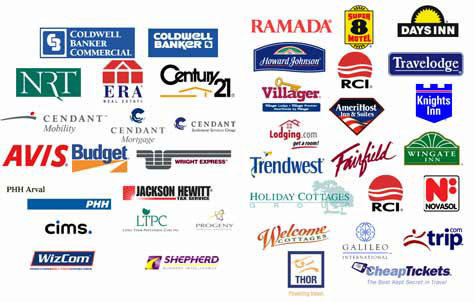
Cendant, the $18 billion conglomerate that was built through the acquisitions of dozens of the nation's most prominent businesses like Century 21, Avis, Days Inn and Orbitz, is planning a radical breakup into four different companies.

The move, which company announced today, is perhaps the most vivid acknowledgment that the latest era of conglomerates built through mergers and acquisitions may be over.

Under the plan approved by Cendant's board Sunday, the company will be divided into four parts - one each for Cendant's real estate, travel distribution, hospitality and vehicle rental businesses. Each unit will be spun off into a separate publicly traded company. Current Cendant shareholders will receive shares in each and will continue to receive dividends. For customers and employees, the change should mean little, at least in the near term.
...
The breakup of big conglomerates like Cendant is being driven in large part by investors' newfound desire for companies to be more focused and narrow - what bankers and analysts like to call "pure plays" - as opposed to large empires with disparate businesses. The stock prices of many big companies, like General Electric and Citigroup, have suffered in recent years, and some analysts attribute their sluggishness to what is often called a "conglomerate discount."
...
For Cendant, which also owns the Budget rental car system, Ramada and Super 8 hotels and the Coldwell Banker real estate business, among others, the breakup is a complete about-face aimed at reviving its lagging stock price, which has remained stagnant ever since the company merged with CUC International in 1997. It was later discovered that CUC had been involved in what was then considered the largest accounting fraud in history. Cendant's stock price has hovered from $20 to $25 over the last two years and closed Friday at $20.90 a share.
...
Mr. Silverman, the company's largest shareholder, called his conglomerate strategy a "financial success, but a stock market failure," noting that the company is financially strong, but that investors have not rewarded the company's stock price.

"You can have a great business strategy, but if it's not moving the stock price, it's not working," he said. "This is a classic case of the sum of the parts is worth more than the whole."
...
Still, not all breakups or spin-offs have worked. Viacom's stock price, for example, has not moved much higher since it announced its plan to split in two, leading some investors to question whether such moves really "unlock shareholder value." Even Mr. Rietbrock mentioned in his note about Cendant that, "we're typically cynical of financial engineering that only rearranges the pieces of the puzzle."

However, Mr. Rietbrock and Cendant may have reason to believe that its split will increase the company's share price. Over the past year, Cendant has spun off three different units; in both cases, investors benefited. Other historical examples, like the breakup of Dun & Bradstreet , resulted in huge gains.


Cendant traded up briefly, then tanked on an otherwise bullish session, down 6.77% to $18.77. So is this a buying opportunity? Will the value of the underlying companies be unleashed?

I question that premise. What underlying value? The travel industry has been terrible, and that's basically three out of the four parts of the new Cendant. And profitable units, like income tax preparer Jackson Hewitt have already been sold off. TheStreet.com today discussed Cendant's terrible performance.

The company said the market's valuation doesn't reflect its businesses' strong operating and financial performance, but Cendant delivered a weak third-quarter report card Monday and an ominous forecast about its consumer travel businesses. The company said earnings will be 44 cents a share, at the low end of guidance and below the 46-cent consensus from Thomson First Call.

Yeah, sign me up for that.

TheStreet.com pointed out that Expedia is down since Barry Diller spun it off. Why would Wall Street treat Orbitz any differently? Personally, I'm finding that more companies are offering their lowest rates on their own websites. I use Orbitz for a quick comparison on flights and car rentals. I find the cheapest option, and then go to that company's own website to pull the trigger on the transaction, saving me a few bucks. I'm using Orbitz, in the worst sense of the word, using their tools and bandwidth, leaving them nothing. Sounds like a money maker to me.

How about the real estate holdings (Century 21 and Coldwell Banker)? Yeah, I want to throw money into that industry after its peak. With Craigslist, more people are selling FSBO, or with cut-rate firms like Foxtons. I have a feeling the money's been made here already.

With all these good feelings about Cendant in mind, I pulled the Free Cash Flow numbers for CD off of Morningstar.com. I admit I'm new to this, but these numbers are a horrific sight to behold. I assume that much of Cendant's free cash went into its diverse array of acquisitions, but still, check 'em out:

96 - 93.8
97 - (1042.7)
98 - (1993.8)
99 - 377
00 - 1168
01 - (12,486)
02 - (16,310)
03 - (8043)
04 - (7620)
TTM (5249)

Yes, that's three positive FCF years out of ten. Since 01, Cendant's free cash flow has been NEGATIVE 50 BILLION DOLLARS. Ooof. Say it with a Dr. Evil voice. $50B is just not funny.

So we're left with two piddling positive arguments:
1. The new companies will not be sullied with the controversial Cendant name; and
2. The new companies will be easier to value independently, as opposed to being valued in conglomerate form?

I'm not sure I want to be around next summer when the market values these travel and real-estate companies on their own. It could get uglier than this mashed-up mess called Cendant.

21 October 2005

Peaty Goodness


Just back from Scotland, where I did my best to neglect the Pig. I visited Edinburgh and Glasgow, with a tour of the Highlands in between. What does a tourist do in the Highlands, apart from gawk at the ubiquitous sheep and bison-like brown cows? Visit Scotch whisky distilleries.

Walking by huge copper pot stills and oak vats, I felt as though I was in an oversized chem lab, but instead of precipitating out para-dichloro-benzene, the workers here were making spirits, sweet spirits. As you moved along the whisky-making process, the scents, or really, smells dominated my senses. Bright beery yeast in one room, alcohol in another, and finally the cool mustiness of the storage cellars where casks of ageing whisky lie dormant, slowly absorbing the flavors of the former sherry casks.

My tastes run the spectrum of whiskies, across Scottish geography. My preferences also cross various distillery parent companies. The lighter Speyside whiskies I enjoy, Macallan and Glenfiddich, are owned by the Edrington Group and William Grant & Sons. Edrington also owns the vile Cutty Sark, a.k.a. "The Shark" for its unwelcome bite. Glenlivet is pretty good, and is owned by Chivas Brothers, now a subsidiary of Pernod Ricard. Moving westard and peatier, Oban and Lagavulin are both excellent and operated by Diageo. LVMH Moët Hennessy Louis Vuitton owns Glenmorangie, a light single malt often mentioned as one favored among women whisky drinkers.

Investing in most of these companies is more difficult than finding a bottle of Glenfiddich's 21-year-old Havana Reserve here in the US. Edrington and William Grant are privately-held. LVMH and Pernod Ricard are public... in France.

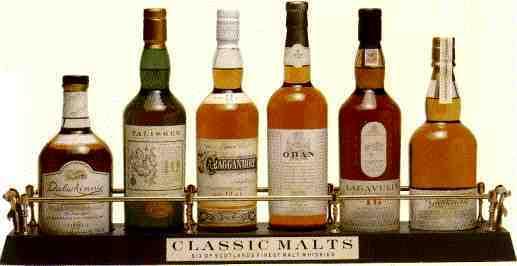
That leaves Diageo, which happens to trade on the NYSE as DEO. Diageo smartly markets its diverse range of single malts under the mark "Classic Malts of Scotland" pictured atop this post. Diageo also owns unrelated booze that's quite popular in my home: Guinness, Tanqueray, and Baileys.

I worked through a quick discounted free cash flow model for DEO from my vacation reading, using the following figures:

current stock price = $57.80;
shares outstanding = 762.592 million;
current year free cash flow = $2456 million;
next year free cash flow = $2701.6 million (10% increase);
perpetuity growth rate (g) = 3%; and
discount rate (R) = 10%

Morningstar only had FCF figures for DEO since '02. FCF increase from '02-'03 was 62.4%, and '03-'04 was 31.1%. The lack of additional data led me to make up the 10% annual increase for the model. Using these assumptions, I came up with a per share value for DEO of $79.69. This is 37.9% higher than the current market price for a share of DEO. My model could be a bit dear, a wee bit optimistic.

Looking at some data from Smartmoney.com, DEO has a PEG of 1.32, a bit lower than its competition. It also sports a dividend yield of 3.81%. That seems a generous number for this industry.

Now I don't feel so bad that my only Scotch investing option is Diageo.

20 October 2005

Vacation Reading

I'm back from a wonderful vacation in Scotland (plus a whirlwind weekend in Paris). I brought one book with me for the flight, since we were trying to keep our bags light. Our jaunt to the Continent on Ryanair, the bargain European airliner, required us to keep our luggage under approximately 35 lbs, or we would have been charged hefty fees depending on how much heft we brought with us from the States. So I left the hardcover Potter books at home, and took with me The Five Rules for Successful Stock Investing by Pat Dorsey at Morningstar. I thank John Coumarianos for the excellent recommendation.

The investing philosophy espoused by Dorsey is prudent, long-term, value-based, and research-intensive. It's not a book on trading, nor will its lessons help me discern wonderful speculative plays. The first half examines how to evaluate companies and stocks, culminating in applying a valuation method. The second half (which I have left mostly unread) analyzes individual industries. I will be using Dorsey's book as a reference onward in this blog, specifically on figuring out core long-term portfolio positions.

So let's see what I may have learned over my vacation.

The remainder of this post is a straightforward nerd-o-rama focusing on stock valuation. My next post will get into some of the really fun things I did in Scotland and how those experiences may have triggered some pursuable investment ideas. So unless your name is Louis, Gilbert, or Booger, you should have stopped reading already.


I tried out the Discounted Cash Flow model described in chapter ten on Wal-Mart, since that's the stock with which I started down this slippery slope. I'll try to be as clear as possible, in case you want to play along.

My starting assumptions for WMT were culled from data at Morningstar.com and Marketwatch.com:

Current stock price: $45.60
Shares outstanding: 4160 million
This year's free cash flow (millions): $2151
Next year's free cash flow (millions): $2688.75
Perpetuity growth rate (g): 3%
Discount rate (R): 9%

I arrived at next year's free cash flow figure of $2688.75 by multiplying this year's free cash flow of $2151 by 25% and adding to $2151. Why 25%? I looked at WMT's free cash flow figures for the past five years and calculated how much they changed year to year. The average change was +26.6% ('01-'02 = 20.2%; '02-'03 = 69.3%; '03-'04 = 79.0%; '04-'05 = -62.2%). 25% is just an easier number to use than 26.6%, and it's only a model.

Taking these numbers, I calculated the free cash flow (FCF) forecast for the next ten years assuming the 25% growth rate:

FCF
Year 1 = 2688.75
Year 2 = 3360.94
Year 3 = 4201.17
Year 4 = 5251.46
Year 5 = 6564.33
Year 6 = 8205.41
Year 7 = 10256.76
Year 8 = 12820.95
Year 9 = 16026.19
Year 10 = 20032.74

Still with me? I then calculated the discounted free cash flow (DFCF) by taking the above free cash flow numbers and dividing them by the discount factor of (1+R)^N, where N = year being discounted. For example the discount factor in year 2 is (1 + .09)^2 = (1.09)(1.09) = 1.19. In year 4, the discount factor is (1.09)^4 = (1.09)(1.09)(1.09)(1.09) = 1.41.

DFCF
Year 1 = 2266.74
Year 2 = 2824.32
Year 3 = 3231.67
Year 4 = 3724.44
Year 5 = 4262.55
Year 6 = 4884.17
Year 7 = 5604.79
Year 8 = 6442.69
Year 9 = 7385.34
Year 10 = 8452.63

Next, I calculated the perpetuity value and discounted it to the present: Year 10 FCF x (1+g)/(R-g)

(20032.74 x 1.03)/(.09-.03) = 343895.37
Discounting the perpetuity value = 343895.37/1.09^10 = 145103.53

The total equity value is the sum of the ten DFCFs and the discounted perpetuity value:
89408.70 + 145103.53 = 234512.23

The per share value is total equity value divided by shares outstanding:
234512.23/4160 = $56.37

So according to this model, applying my somewhat-informed assumptions, WMT is worth $56.37. So WMT is $10.77 or 19.1% undervalued according to its current price of $45.60. My earlier attempt at a valuation of WMT came to $76.98, making WMT look like the 50-cent dollar. This model adapted from my vacation reading makes WMT an 80-cent dollar.

06 October 2005

Chinese Hot Mustard Potato Chips


Poore Brothers made a Chinese hot mustard flavored potato chip variety way back in 1996. I discovered this delicacy at America's best-named supermarket, Schnucks. This was the yummiest variety, spicier than the jalapeno chips, and more interesting than barbecue. It was a flavor unique to Poore. I remember these chips ten years hence. Then the Chinese mustard chips disappeared. Couldn't even drum up an image of them from Google.

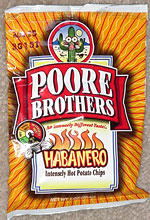
And I basically stopped buying Poore Brothers snack foods. I later tried their habanero chips pictured to the left, but they just weren't the same. They weren't special.

Isn't this a great introduction to a company? Makes you want to go out and buy 1000 shares, just on this anecdote alone. Fortunately, I'm no Cramer. All five of my readers, (six, maybe seven) require much more than a pronoucement from the Pig to make a stock move.

Apparently, Poore Brothers has moved onto making snack foods with the TGI Friday's brand, and as you'll read below, the Cinnabon brand. I've seen the TGI Friday's potato skin snacks in the firm's vending machine. I am now avoiding most starchy, carby foods in a so-far-successful attempt to get back to my law school fighting weight. But I can indulge in stocks of salty snack peddlers like Poore Brothers (SNAK). I just can't take another disappointment like back in '96.

Here's a piece by Will Ashworth from fool.com, posted on September 15, A Stock to Snack On

Investors looking for small-cap stocks tend to seek out companies
whose sales and profits are growing faster than the market as a whole,
or have the potential to do so. One such company is Arizona-based
Poore Brothers (Nasdaq: SNAK), which manufactures snack products such
as chips, potato skins, and cookies.

I'm constantly looking for opportunities to invest in products that I
either use or am familiar with.
Snack-food manufacturers have
historically carried low profit margins, so I wasn't really searching
for this type of business when I ran across it. Why, then, did I have
a change of heart?


Seems as though the writer of this piece and I came around to Poore Brothers as an investible company in a similar fashion. Full disclosure, I was taking a break from patent study, perusing the NASDAQ losers list today (which was quite lengthy) and came across the familiar logo of Poore Brothers. The mix of hunger and law study must've prompted memories of eating their spicy chips during my first year of law school.

Hidden among the company's various press releases for the past year
was an award it received for its new Cinnabon cookie line. The press
release implied that the rollout had achieved a level of retailer
interest the company hadn't expected. Poore Brothers had a potential
hit on their hands, and small-cap growth stocks are sometimes driven
by these types of business anomalies -- the sort that launch a company
into the stratosphere of growth. Poore Brothers might be poised for
such a dramatic rise, but not yet; Cinnabon cookies still make up a
relatively small portion of sales.

Also worth noting: the new business strategy the company began in late
2004. In a press release, CEO Thomas Freeze stated the company's
intent to expand beyond salted snack products in an effort to broaden
its product portfolio.

The company's plan has five basic points:

Develop, acquire, or license additional niche food brands like the
Cinnabon cookies. According to the company, the initial reaction has
been overwhelmingly positive.

Seek additional distribution for existing brands. To that end, Poore
Brothers has begun shipping products into Canada, although I've yet to
encounter them in the stores. I suppose I'll have to look more closely
the next time I'm out shopping.

Develop product extensions for existing brands. For example, the
company introduced TGI Friday's-branded meat snacks in May to
complement its existing TGI Friday's potato skins.

Increase the capacity of its two plants, which currently operate
between 40% and 50% of capacity. To that end, Poore Brothers is
securing private-label potato chip business with local grocery stores.
It's too early to determine whether this effort has been a success.

Make a concerted effort to increase margins. The company seeks to
improve efficiencies wherever possible and focus on higher-margin
products. Second-quarter operating margins increased from 23.5% to
25.9%.
A quick check on financials reveals decent second-quarter results,
with revenue up 34% and profits up 7.3%. (That's net of the costs
associated with discontinuing their Crunch Toons brand of salted
snacks in 2004.) Those trends should continue to improve, assuming the
company is able to improve capacity utilization.

Poore Brothers is making a compelling case for growth, provided it can
license brands in a cost-effective and scalable way. Their five-point
plan has some merit, but at the end of the day, the snack-food
industry is littered with casualties that tried taking on Pepsi's
(NYSE: PEP) massive Frito-Lay division.

The major drawbacks to investing in the company at this point are
twofold. Licensing is a risky proposition, as evidenced by the $2
million writedown that accompanied the shuttering of the Crunch Toons
line. In addition, an awful lot has to go right for their five-point
plan to work. It's anything but a sure thing.

So the question remains: Will Poore Brothers live up to its namesake?


There are some interesting brands discussed here. I performed some extensive polling in my living room and found that the Cinnabon brand scores very highly. The TGI Friday's brand less so, but I'm a New York Snob that frowns upon casual dining chains. That bit of poll data is probably skewing a bit negative.

Buffett is quite the fan of brand value. I know I'm putting myself out there for criticism for siding with the Oracle, but I too appreciate the intangible value of branding, except when the brand is World Poker Tour (see yesterday's post, as well as today's NASDAQ new 52-week low list). Poore's brands are enticing.

Expanding distribution into Canada seems like another good idea. Wonderful country with a booming economy. The Economist says Canada is at the beginning of a seven to ten year investment cycle. And the NHL is back, which means Canadians (and perhaps a few Flyers fans) will be excitedly watching the games and hopefully upping their snack intake.

Fine, fine. That last argument was quite a stretch. I think it's time I brought in the numbers:

Ticker/Share Price(as of whenever I checked during the evening of 10/5/05)/PEG/ROIC/Enterprise Value/CNBC Stock Scouter Score (Data is from smartmoney.com, unless it's from CNBC)

SNAK - $4.89 - 0.77 - $4.58 - 9/10
Its 52-week range is $2.56-$6.88, with the 52-week high coming less than one month ago.

These are pretty solid numbers. I wouldn't be thrilled with the near 30% drop over the last four weeks if I had a position in SNAK, but it means the stock is getting cheaper by the day. It also means that this is a volatile micro-cap stock that is a much riskier proposition than many of the other WershovenistPig Stock Watch List choices. Nevertheless, I'm throwing TGI Friday's-branded meat snacks (and Cinnabon snacks for dessert) into the trough.

04 October 2005

Visiting the Casinos


Thought I'd virtually visit some casinos since I have been withholding any trips to AC until I pass the pesky patent bar. And no, I don't touch online poker. I derive pleasure from many aspects of the game. I enjoy the tactile feel of the chips, cards, and felt. I savor the face-to-face competition. You meet such memorable characters at a $6/12 table (and especially at a $2/4). And you can't get cheesesteaks from the White House on the internet.

I would read some articles and re-evaluate my casino stock picks.

I found one piece on thestreet.com on the potential revitalization of Trump's recently bankrupt casinos, and another on the freefall of World Poker Tour's stock. Neither article convinced me to take another look at TRMP or WPTE. Instead, I'm feeling much more confident about all three current picks, BYD, HET, and IGT.

First off, the Trump piece:

The competition has run away from Trump, leaving his collection of ragged casinos littering the boardwalk. And the AC Marina, too. The Marina has three casinos, the Borgata, Harrah's Marina, and an unrenovated dump owned by Trump. I don't see how Trump can catch up, refinanced debt or not.

From 2000 through 2004, total capital spending at Trump's Taj Mahal on the northern end of the Atlantic City boardwalk was $110.3 million, according to figures from the New Jersey Casino Control Commission. Over the same period, capital spending at Aztar's (AZR:NYSE) Tropicana was $374.4 million and $262 million at Harrah's Entertainment's (HET:NYSE) Showboat.

That period also saw the July 2003 grand opening of the Borgata, a $1.1 billion joint venture of Boyd Gaming (BYD:NYSE) and MGM Mirage (MGM:NYSE) that upped the ante in Atlantic City. With 2,000 room and suites, 11 restaurants, 11 boutiques, a spa and theater, the Borgata draws well-heeled overnight visitors interested in a multifaceted experience.

The resort has vaulted to the top of the pack, with net revenue for the first six months of this year outpacing the closest competitor, Bally's Atlantic City, by $50 million. Bally's is owned by Harrah's.
...
Perry and his lieutenants are working on a capital spending plan, which they hope to share with investors by the end of the year. It could include renovations to casino floors and restaurants, as well as new concept restaurants. They're also working on plans for a new hotel tower at the Taj Mahal, which could add 1,250 rooms, although such a project would take about three years to complete.
...
After addressing some of its immediate challenges, Trump Entertainment might seek to expand into other markets, Perry said in the second-quarter call. The company's announcement Monday that it had entered into an option to lease an 18-acre plot in Philadelphia shows it's already making plans to do that.

However, even as Trump's new executives roll up their sleeves, competitors aren't standing still. The Borgata is planning a $200 million public-space expansion to be completed next spring and a $325 million 800-room hotel expansion scheduled for the fourth quarter of 2007.
Next year, Caesars plans to open "The Pier," a 500,000 square-foot dining, shopping and entertainment complex on the boardwalk.
...
As for the stock, which has navigated a range of $12 to $21.50, Noland considers it fully valued around $19 and has encouraged investors to buy it on significant dips. Shares closed at $18 Monday. Noland owns no positions in Trump Entertainment and Gimme Credit does no business with the company.


So as a potential investor, I have to wait three years for the possibility that the Taj Mahal will be expanded. And I have to hope that the city-that-elected-John-Street-mayor-twice will get its act together to do what? Throw together some slot machines?

Too many maybes for me. What excites me, moreso than pocket aces, is the revitalization of Caesars and Showboat, the revenue generation of the centrally-located Bally's, and the much-needed expansion of the Borgata. This is the future of Atlantic City. And which companies are behind these moves? HET, BYD, and MGM.

Before I move onto the numbers that justify my beliefs, let's take a quick look at a fool named Jeff Hwang, from Motley Fool who somehow attempts to justify considering WPTE:

Does WPT have a business or doesn't it? If so, is parent Lakes Entertainment (OTC BB: LACO.PK) the better value? And if so, should you be willing to touch Lakes with a 10-foot pole? I gotta confess: As soon as I wrote that, I lost all interest in both stocks.

I mean, why even bother looking at a company where I have to ask those kinds of questions? After all, I've been buying three other high-quality companies for my own portfolio lately: Barry Diller's InterActiveCorp(NYSE: IACI), IAC's recently spun-off online travel leader Expedia(Nasdaq: EXPE), and slot machine giant International Game Technology(NYSE: IGT). All of them have legitimate businesses, generate bucketloads of cash, and look very much like values at current prices.

Last time, I concluded that if WPT's currently deserted online gaming business ends up being worth anything at all, the stock has legitimate upside, but that the rest of the business was worth only about half the stock's market price.

As it turns out, the stock closed yesterday at $8.84 per share, a mere 10.5% premium to WPT's $8-per-share IPO price in August 2004. A big reason for the decline was online gaming leader Party Gaming's (LSE: PRTY)prediction earlier this month that growth rates would slow. If the online gaming market isn't going to be as big as everybody thought, then obviously WPT's potential in that area is slimmer, particularly if it can't shake its current status as a fringe player.
...
On the other hand, despite the questions surrounding the potential of its online gaming business, WPT is starting to look interesting. The company's media and product licensing business is legitimately profitable. (That said, I also think that Harrah's Entertainment(NYSE: HET) -- another stock that is starting to look attractive after its recent pullback -- represents a much tougher competitor than I previously believed, especially since its acquisition of Caesars extends the reach of its World Series tournament circuit.) In addition, I believe that WPT's brand value is increasing as the company continues to further penetrate international markets, which should support the online business, at worst, as a means of cheap and effective marketing.

Should the stock fall much further, I think that investors may be able to purchase WPT's media and product-licensing businesses -- plus the brand -- at fair value and get the online business for free. To me, that looks a lot like a value opportunity.


I'm having a bit of trouble taking this writer's views seriously. The World Poker Tour is an entertaining bit of television, but is it a brand worth hundreds of millions of dollars? Even more than the Trump brand, there's a whole lotta nothing backing the WPT.

The World Series of Poker brand is just as marketable and valuable, and has a fundamentally strong company backing it up, Harrah's.

Side note: I reluctantly find myself in agreement with Jeff Hwang about IGT.

I'm letting it ride over on the WershovenistPig Stock Watch List, not making any changes in the casinos. So let's quickly get the numbers out of the way:

Ticker/Share Price(as of whenever I checked during the afternoon of 10/4/05)/PEG/ROIC/Enterprise Value/CNBC Stock Scouter Score
(Data is from smartmoney.com, unless it's from CNBC)

TRMP - $17.85 - na - na - na - na
HET - $66.26 - 1.27 - 3.71% - $172.32 - 6/10
BYD - $42.85 - 0.99 - 5.79% - $65.73 - 4/10
MGM - $44.33 - 1.53 - 4.01% - na - 7/10
AZR - $31.43 - 1.86 - 3.17% - $47.03 - 5/10
PENN - $31.48 - 1.16 - 6.27% - $35.38 - 3/10
IGT - $27.92 - 1.44 - 15.15% - $24.95 - 10/10

HET has a decent PEG, and a surprisingly high enterprise value. Might have to check smartmoney.com's numbers on that. BYD has a PEG just below 1, a high ROIC compared to its peers, and a share price below its enterprise value. And IGT has an even higher ROIC and some significant recent insider buying.

Now I got to get some studying done and get this whole patent attorney thing squared. And then I can go satisfy my poker jones.

03 October 2005

Do Buybacks Equal Greenbacks?

I was perusing the Times business headlines while taking a quick break from patent bar study. (Yes, posts should be fewer this week. If they aren't, I'm not studying enough.) A piece by Amy Feldman, excerpted below, caught my greedy eye. Its premise: that companies doing share repurchases, or buybacks, offer a higher return for investors than owning shares in companies that do not announce buybacks.

Sending Out a Message by Buying Back Shares

Companies have been repurchasing their own shares at record levels,
and the trend shows no sign of letting up. In the first half of this
year, share buybacks reached $163 billion, according to Standard &
Poor's, up 91 percent from the first six months of 2004. Howard
Silverblatt, an equity market analyst at S.& P., estimates that they
will surpass $300 billion for the year. That would be well above the
$197 billion for all of 2004.

Companies are splurging on their own shares for a simple reason: they
have a lot of cash and need to do something with it.
...
"Companies have more cash than they know what to do with," Mr.
Silverblatt said. "The number is just huge, especially in an
environment where it is cheap to get money. So companies have plenty
of money to do buybacks."

In general, buybacks are good for investors. After all, they represent a vote of confidence by management in the company's stock. And all things being equal, buybacks increase the earnings for each share by decreasing the number of shares held by investors.


Ok, so the Times is recognizing a huge trend among companies. Buybacks are the cool thing among CEO's and CFO's. But when something becomes cool, poseurs tend to follow along. So one should be on the lookout for which companies have the fundamentals to back up the stock repurchase versus the poseurs puffing up their chests and attempting to look strong.

David L. Ikenberry, a finance professor at the University of Illinois
at Urbana-Champaign who studies corporate buybacks, found that the stock price of companies that announced buybacks tended to outperform those that did not.

In an unpublished study of 7,725 announced corporate buybacks from 1980 to 2000, Mr. Ikenberry and three other researchers found that investors who held those stocks for four years earned a return that was 15.6 percentage points higher than that of a similar basket of stocks from companies that might or might not have announced repurchases. The results were consistent with a similar study
published in the Journal of Financial Economics in October 1995 by Mr. Ikenberry and two other academics that focused on stock buybacks from 1980 to 1990. The study is at http://papers.ssrn.com/sol3/papers.cfm?abstract_id=686567.


A 15.6% difference over four years isn't an outsized megamillions-style gain. But there could be something to this. On a $50,000 portfolio, that comes out to a difference of $7,800. Nice.

Sorry for the interruption, let's continue with the Times. They don't really care for the rude interruptions.

"It is a phenomenon that is fairly robust," Mr. Ikenberry said.
"Companies buy back stock for all kinds of reasons. The biggest one is
a perception of mispricing. So these stock buybacks are considered
signals that management is confident of where the stock prices should be headed.
"
...
But not every buyback announcement is significant. Not all companies that say they will buy back shares actually do. And many buybacks - particularly among technology companies - are simply a way of offsetting the dilution that would otherwise accompany the exercise of stock options. "So many companies are doing buybacks, but they may not all be doing meaningful buybacks in the sense that they are big enough to give the company a reduced share count," said David R. Fried, president of Fried Asset Management in Pacific Palisades, Calif., and editor of the online newsletter buybackletter.com.

That said, more companies are doing meaningful buybacks these days and
some in huge quantity. Consider Exxon Mobil, the world's largest
energy company. As oil prices have soared, it has accumulated cash,
and it has been sharply increasing its share repurchases, up to $5
billion in the third quarter from $3.7 billion in the second quarter.
...
AND the buyback announcements keep coming, sometimes from companies
that have gone through tough times - like Time Warner and Motorola.
"They've had some problems recently, and they're trying to do some
signaling to the market," says Timothy Loughran, a finance professor
at the University of Notre Dame.

...
If you're interested in investing in companies that have had buybacks,
Mr. Fried recommends looking at valuations as well as the size of the
buyback programs. Among the stocks he likes are AutoZone, the auto
parts retailer, trading at 12 times earnings; Intuit, the maker of
Quicken software, trading at a multiple of 22; and Cigna, the insurer,
at a multiple of 8. "We look for situations where you've got the
buybacks and the valuations," he said.


I left out some of the boring parts for a change. But not too many.

I also remembered Cramer discussing this topic on his radio and CNBC show, back on September 23. Here's a recap:

Goldman Sachs "knows how to buy back stock," said Cramer. The company
bought back stock last quarter, and the stock is now trading 12%
higher than it was during the buyback, he said. Goldman just announced
another buyback this week, and Cramer expects similar results.

Lockheed Martin (LMT:NYSE - news - research - Cramer's Take), on the
other hand, also announced a buyback this week. But Cramer said
Lockheed's track record isn't so rosy. Last quarter, Lockheed bought
back stock, and the stock is now trading about 5% lower, he said.

The bottom line, said Cramer, is not all buybacks are created equal.
Goldman Sachs knows how to do a buyback. Lockheed Martin failed with
its last buyback and will "probably fail again," he said.


Cramer has a point that one needs to examine the company doing the buyback. I also think Cramer drank the Kool-Aid/read Dianetics/learned the secret handshake while at Goldman, meaning he's a sentimental booster of GS. Of course, the stock did jump recently.

I read on Marketwatch this morning that a company I ignored in my Discount Shopping Thesis posts, Dollar General (DG), announced a plan to repurchase up to 10 million shares over the next year. I checked the number of tradeable shares available in DG. Thestreet.com says there are approximately 321 million. This amounts to a buyback of 3% of outstanding shares.

The big question for me, as you may have seen in the title of this post: Do buybacks equal greenbacks?

How to separate out the good stocks from the wannabes?

Might as well throw out some usual numbers for the diverse array of stocks I culled from my reading:

Ticker/Share Price(as of 10/2/05)/PEG/ROIC/Enterprise Value/CNBC Stock Scouter Score
(Data is from smartmoney.com)

XOM - $63.54 - 1.89 - 27.74% - $59.82 - 9/10
AZO - $83.15 - .80 - 26.56% - $104.00 - 9/10
INTU - $44.81 - 1.32 - 21.53% - $42.27 - 6/10
CI - $117.86 - 1.37 - 24.84% - na - 9/10
TWX - $18.11 - 1.76 - 2.76% - $20.95 - 5/10
MOT - $22.03 - 1.66 - 18.02% - $22.03 - 10/10
DG - $18.34 - 1.06 - 17.88% - $18.40 - 6/10
GS - $121.58 - .87 - 4.01% - na - 9/10
LMT - $61.04 - 1.49 - 11.90% - $64.80 - 6/10

AZO has the best PEG, came in a sweet second on ROIC, and has an enterprise value about 25% higher than its share price. I don't need any more retail stocks on the WershovenistPig Stock Watch List, but this one's too good to ignore.

XOM has the nice ROIC, but I already have my eye on plenty of superior oil and gas stocks. I've got commodities covered.

DG has numbers comparable to FDO, currently residing on the Discount Shopping Thesis list. WMT is currently my pick among those choices, but between DG and FDO, I like the fact that DG is doing the buyback, however meager the 10 million shares authorization turns out to be.

TWX, so maligned (just check out Jeff Jarvis' Buzzmachine for embittered talk of TWX.) It will be interesting to see what TWX does with its AOL subsidiary. Otherwise, the PEG and ROIC are crap. And I'm not excited about media stocks. This stock could be the big poseur in this group.

INTU and CI have nice ROIC numbers. But INTU's enterprise value is below its share price. CI doesn't have an enterprise value, at least on smartmoney.com. Yahoo! Finance has CI's enterprise value below its market cap to the tune of $1B. And CI is at its 52-week high.

MOT and GS have had nice runs as of late. I think a little too rich for me right now, but these are leading companies that could pullback over the next few months. MOT certainly has come off its 52-week highs.

Here's my Buybacks = Greenbacks Basket for the WershovenistPig Stock Watch List:
AZO, INTU, CI, MOT, and GS. Talk about cohesion: an auto parts retailer, accounting software company, health care insurer, cell phone and telecommunications bigshot, and premier investment bank. It's an instantly diversified portfolio. Go me!